
The requirements for nursing school ensure that applicants have the right academic foundation to succeed in the rigorous nursing education. Common nursing school requirements include a minimum GPA, letters of reference, official transcripts, and a personal statement. An Accelerated BSN program may also require a completed degree or college credits.
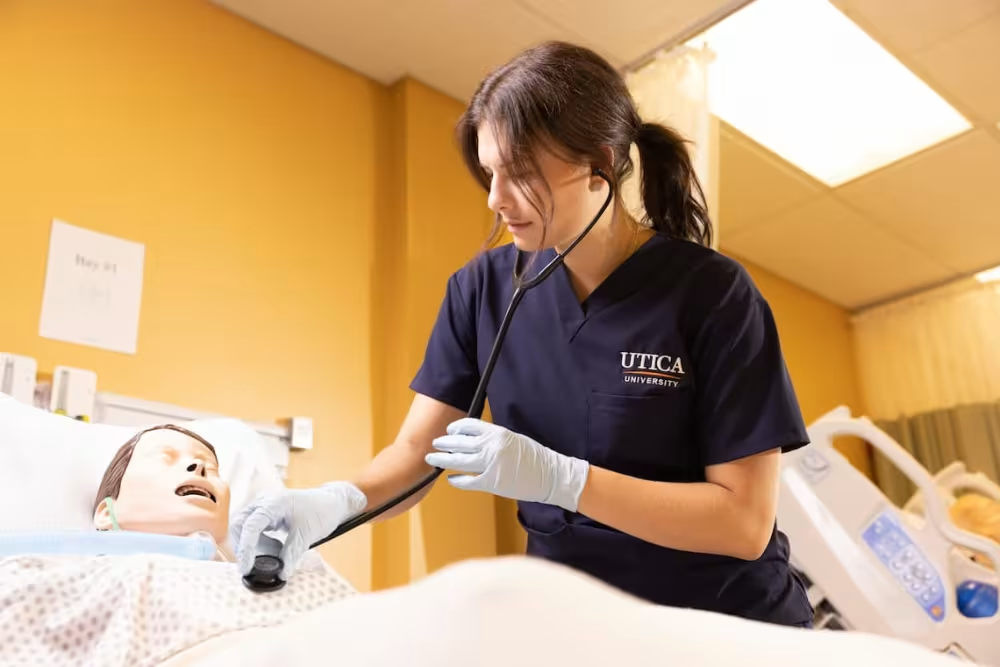
The purpose of nursing school requirements is to ensure that admitted students have the necessary academic foundation to succeed in nursing school. Nursing is a highly technical career that requires a scientific background in chemistry, microbiology, statistics, anatomy and physiology, and more. Program requirements ensure that you are prepared to hit the ground running with both your nursing education and your future career as a nurse.
Meeting nursing degree requirements is particularly important if you’re considering an accelerated program, such as the one at Utica University. Utica’s Accelerated Bachelor of Science in Nursing (ABSN) and Advanced Standing B.S. in Nursing programs offer a faster pathway toward a nursing career by enabling eligible students to earn a B.S. in Nursing in as few as 16 months. The rigorous curriculum and the compressed timeline require that applicants be well prepared to meet the challenge.
As you prepare to navigate Utica’s admission process, take a closer look at the academic requirements and the documentation you’ll need to submit as part of your application package. Then, get some helpful tips for meeting the requirements.
Understanding the Requirements for Nursing School
In Utica’s ABSN program, you’ll take courses in pathophysiology, pharmacology, medical-surgical nursing care, clinical research, and other essential nursing topics. The curriculum requires dedication, and you’ll be expected to devote a great deal of time to studying. An academic foundation of basic scientific competencies is essential to understanding concepts expanded on in the curriculum, which is why nursing schools like Utica establish admission requirements.

Trying to decide where to earn your nursing degree? Learn more about how to choose a nursing school and the paths you can pursue.
Academic Requirements for Nursing School
Utica’s accelerated programs are designed as nursing pathways for career switchers and transfer students, and the academic requirements reflect this. To apply to the ABSN program, you must have either a completed non-nursing bachelor’s degree or at least 65 non-nursing college credits. Alternatively, you may qualify with 60 credit hours in liberal arts, including all non-nursing degree requirement courses.
If you wish to apply to Utica’s Advanced Standing B.S. in Nursing program, you must have a conferred associate degree or 60 credit hours in liberal arts courses, including all the non-nursing degree requirement courses.
At Utica University, we also require applicants to hold a cumulative GPA of at least 2.8 overall and a science GPA of at least 3.0. This shows us that you can complete college-level coursework.
Nursing Degree Requirements: Degree Requirement Courses
You may also need to complete one or more degree requirement courses for nursing school, often referred to as prerequisites. You’ll need to complete each general course with a grade of C or better and a GPA of at least 3.0 for the natural science nurse degree requirement courses.
Not every applicant must complete the same degree requirement courses for nursing school. Your admission representative will review your college transcripts to determine which courses you need to complete before enrollment.
Examples of degree requirement courses you may need to take include:
- Statistics
- Anatomy and physiology I and II with lab
- Chemistry with lab
- Microbiology with lab

Admission Requirements for Nursing School
In addition to the eligibility requirements for nursing school, you must complete all the necessary steps to submit your application. Each nursing school establishes its own requirements, but in general, you may need the following:
Official Transcripts
You will need to arrange for your official transcripts to be submitted from all institutions you have previously attended. You can typically do this via a link on the institution’s website.
Personal Statement
Nursing schools often require a personal statement, also known as an admission essay. You may be provided with an essay prompt to follow.
Take your time writing your personal statement. It should capture your authentic voice and motivations for becoming a nurse. Look for ways to stand out as a nursing school applicant, such as discussing any prior experience volunteering at a hospital or in a similar role.
Before submitting your statement, ask others to read it and offer feedback. Revise as needed and proofread carefully.
Letters of Recommendation
You may need to submit two or three letters of recommendation with your nursing school application. The letters should be written by individuals who know you well but are not friends or family members.
For example, you might request letters from former professors or supervisors. It’s best to ask these individuals for a letter well before the application due date, so they’ll have plenty of time to write a thoughtful letter.
Completed Application
Nursing schools generally offer online applications. Be sure to answer all the questions, as an incomplete application may result in a rejection. Don’t forget to use your resources, however, as your admission representative can review your application prior to submission to ensure it includes everything required.
Interview
Some nursing schools offer the option of having an interview, while others may require it. Think of the interview as a “getting to know you” conversation. Your interviewer will likely ask you questions about why you want to become a nurse and why you want to attend that school. You might also be asked questions about your character, strengths and weaknesses, past experiences, and how you handle stressful situations.
The nursing school interview is also an opportunity for you to ask questions about the school. It’s ideal to come prepared with at least a few questions that you cannot easily answer for yourself by browsing the program’s website. For example, you might want to ask about the instructor-to-student ratio, academic support resources, and NCLEX-RN prep.
Learn how to prepare for nursing school so you can start on track toward success.

Practical Tips for Meeting Nursing Program Requirements
You can turn to your admission representative for help navigating the nursing degree requirements. The following tips can also help:
Confirm Your Credits Will Transfer
You don’t want to go through the effort and expense of completing your degree requirement courses only to find that the nursing program you’re applying to won’t accept credit transfers from that institution. Check with your admission representative before enrolling in any courses, and don’t assume that the credits will transfer just because the course title is the same.
Another option is to complete the degree requirement courses at the nursing school you plan to attend. For example, Utica offers all its required courses online through its e-learning platform.
Consider Your Timeline
Double-check the start dates and session lengths of all degree requirement courses to ensure that you can complete your courses before your target start date for nursing school. A traditional semester course may not work if your target start date is in three months. In that case, accelerated or self-paced degree requirement courses may be best.
Keep Your Representative Informed
The grades you receive on your degree requirement courses will impact your overall GPA, which could then affect your admission into the nursing program of your choice. Be sure to consistently advise your nursing school admission representative about your progress, especially if you’re taking the courses at a separate institution.

Begin Your Nursing Future at Utica University
Fulfilling the nursing school requirements offers an opportunity to prepare for the program’s rigors. Although Utica University’s ABSN and Advanced Standing B.S. in Nursing programs offer a fast-paced curriculum, you’ll have access to extensive student support resources like our Academic Success Coaches. You’ll also work one-on-one with your dedicated admission representative throughout the admission process.
Request information and connect with an admission representative at Utica University today to learn more about the enrollment process at our accelerated program sites in Utica and Albany, New York.
