
With Utica’s ABSN program, you will gain both hard and soft nursing skills for resumes that you need to succeed in the nursing workforce. Employers value when you develop both technical hard skills, like IV insertion and wound care, and interpersonal skills, like empathy and organization.

As a nurse, you need to highlight your high-value skills and abilities on your resume when applying for jobs. By providing a mix of clinical, soft, and specialty skills, you can create a nursing resume that stands out.
At Utica University, you can earn your B.S. in Nursing in as few as 16 months through our Accelerated Bachelor of Science in Nursing (ABSN) program. This program combines comprehensive online coursework, hands‑on skills and simulation labs, and clinical rotations to help you enter the nursing workforce quickly. You will acquire both the hard and soft nursing skills required to practice safely and effectively.
Why the Right Nursing Skills Matter on Your Resume
The right nursing skills are essential on a resume, allowing employers to immediately see the value you would bring to their workplace. Your resume should highlight your technical abilities, as well as the interpersonal abilities you need to be a successful nurse.
Most employers want to see evidence that you have the skills required for the nursing role and to ensure that every patient is safe. Including relevant specializations and certifications on your nursing resume shows potential employers that you are ready to take on specialized roles.
Nursing School and Your Nursing Resume
Many employers prefer hiring nurses with at least a bachelor’s-level education because of the expansion and increased professionalization of the nursing role. Although you may be able to work as a nurse with an Associate Degree in Nursing (ADN), this degree type will restrict you from opportunities. You can advance more quickly in your career and pursue more specialized roles with a B.S. in Nursing.
If you already have a non-bachelor’s degree or a certain number of non-nursing college credits, earning your B.S. in Nursing through an ABSN program could be your path to a nursing career. After graduating from an ABSN program, you will have the hard and soft skills needed to be a competent practitioner.

Learn why now is the perfect time to become a nurse with a non-nursing bachelor’s degree.
Hard Skills vs. Soft Skills in Nursing
Your nursing resume should show a balance of hard and soft nursing skills. Hard skills demonstrate your clinical expertise, while soft skills enable you to work effectively with patients and colleagues.
When combined, these competencies present you as a well-rounded professional ready to contribute to the healthcare team.
An Overview of Hard Skills
Hard skills are specific, teachable nursing abilities that directly translate to clinical practice. As a student in our ABSN program, you will learn the necessary hard skills to be successful in your nursing career through a curriculum that delivers online coursework, clinical skills and nursing simulation labs, and clinical placements.
Hard nursing skills you will develop as an ABSN student include:
- Administering medications
- Electronic health record (EHR) management
- Infection control procedures
- IV insertion and management
- Patient assessment and monitoring
- Vital signs measurement
- Wound care management
An Overview of Soft Skills
Soft skills in a nursing context are behavioral traits that shape how nurses interact with colleagues and patients. You will develop soft skills as an ABSN student through communication with peers and mentors, group study opportunities, and the administration of care to real patients during clinical rotations.
Soft nursing skills to develop as an ABSN student include:
- Adaptability
- Attention to detail
- Communication
- Compassion
- Critical thinking
- Empathy
- Organization
- Problem-solving
- Teamwork
- Time management
Top Hard Skills to Include on a Nursing Resume
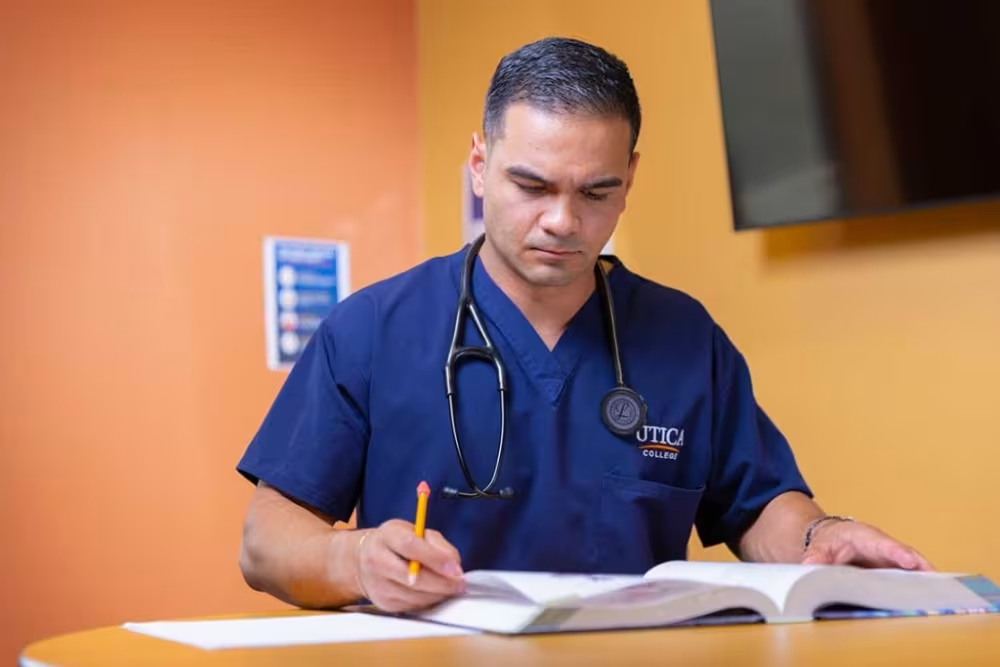
As a practicing nurse, you will rely daily on clinical skills you gained in nursing school. These hard skills are essential to keep patients safe and deliver high-quality care.
A critical hard skill to highlight on your nursing resume is clinical assessment and monitoring. Evaluating your patients’ vital signs and physical conditions and rapidly intervening when needed is essential to quality care. You must also be able to properly administer and manage medications by accurately calculating dosages and understanding drug interactions.
Other hard skills to include on your resume may include wound care management, infection prevention, patient education, and proficiency in managing and updating electronic records, or EHRs.
Top Soft Skills for Nurses That Employers Value
Nurses also need soft skills that ensure patient safety and improve outcomes. Teamwork and communication are foundational to nursing practices because of the constant relaying of information to patients and other healthcare teams.
Along with building trust with your patients, empathy and compassion guide the care you deliver. You also need strong problem‑solving and critical‑thinking abilities to analyze situations and make quick decisions.
Since nurses work in fast-paced, often hectic environments, you need strong time management skills to prioritize important tasks and balance smaller ones. Organizational skills and attention to detail are also critical, as noticing even the smallest change in a patient’s status can make a big difference.
What do nurses do? Explore everything you need to know about pursuing a career in nursing.

How to Highlight Nursing Skills Effectively on Your Resume
To highlight your nursing skills, your nursing resume should be organized in such a way that employers can easily scan and have a general idea of your skills and experience. Create sections that separate your hard skills from your soft skills, while using strong action verbs to describe your experiences.
Nursing Resume Examples
When creating your nursing resume, you might find it helpful to search for nursing resume examples and templates online. The template you select should use space efficiently, be well organized in presenting information, and enhance readability with bullet points and bold text.
Don’t forget to tailor your resume for each position you apply for by using the job description and incorporating relevant keywords.
Pursue Your Nursing Career at Utica University
After learning how nursing skills for resumes can improve your job search, you may be ready to take the first step in pursuing your nursing career. At Utica University, our immersive approach to learning, alongside clinical rotations, will enable you to develop both soft and hard skills quickly.
If you want to learn more, request information and connect with an admission representative about our ABSN program.
